Taking a US phone to JapanThe number and the data are separate problems
All three major US carriers cover Japan, but they charge in two completely different shapes — and the argument about which is cheaper collapses once you separate the two jobs your phone is doing.
The usual version of this question is framed as a choice between your carrier and a Japanese eSIM, as though you had to pick one. You do not. A modern phone can hold your US line and a Japanese data plan at the same time, and the sensible setup for most trips uses both — the US line for the number, the Japanese plan for everything that costs money by the megabyte.
What that leaves is a second question nobody frames at all: whichever way you get online, some service you rely on is going to look at where you appear to be and change its behaviour. That is the part we can measure, and it is where this page spends its time.
- Verizon and AT&T charge per day you use the phone; T-Mobile includes it in the plan
- Your US number and your data are two decisions, not one
- A dual-SIM phone keeps the number live while Japanese data carries the traffic
- A Japanese address fixes Japanese services and makes your home ones suspicious
- All seven VPN providers we track publish locations in both the US and Japan
- We measured Tokyo: roughly half of a raw line survived the tunnel
Quick answer: roaming or a Japan eSIM?
If you are on T-Mobile and your plan is one of the Experience tiers, your phone already has data in Japan and you can land and use it. Nothing to buy.
If you are on Verizon or AT&T, both sell a day pass that charges you for each day you use the phone. For a short trip that is simple and predictable. For a longer one, the arithmetic stops working, because a per-day charge keeps running while a local plan does not.
If you are travelling with family on Verizon or AT&T, the day passes are charged per line, which is where the bill grows faster than people expect.
The arrangement that suits most trips longer than a few days is to keep the US line active for calls and messages, buy Japanese data separately, and turn data roaming off on the US line. The rest of this page is how to do that without losing anything.
Does Verizon work in Japan?
Yes. Verizon publishes Japan among its international destinations, and the usual way to use it is TravelPass, which is charged for each day you actually use the phone.
| Carrier | How it charges | What they publish |
|---|---|---|
| Verizon | Charged per day you use it | TravelPass — $12/day per line International Monthly Plan — $100/mo per line |
| AT&T | Charged per day you use it | International Day Pass — $12 per 24 hours |
| T-Mobile | Included in the plan itself | Experience Beyond — プランに含まれる Experience More — プランに含まれる |
Read from each carrier's own pages on 2026-10-02. These are the only US carrier figures on this page and we do not collect them automatically, so check the carrier's page for the current number before you rely on it. Taxes and plan conditions are theirs, not ours.
Verizon also publishes a monthly international plan, which is the one that makes sense when a trip stops being a trip. The crossover is simple arithmetic: a per-day charge multiplied by the number of days you will actually use the phone, against the monthly figure.
The way a day pass surprises people is that it triggers on use rather than on intention. A phone left on in your pocket can sync mail and start a charged day you did not plan to have, and every line on the account that does the same thing starts its own. If you intend to use local data instead, the step that matters is turning data roaming off on the US line — not merely promising yourself you will not browse.
Does AT&T work in Japan?
Yes. AT&T's International Day Pass covers Japan, and the structure is the same idea as Verizon's: a flat charge for each 24-hour period in which you use the phone, with your existing domestic allowances carried over for that day.
AT&T publishes a lower charge for each additional line on the same account used on the same day, which makes a family trip cheaper on AT&T's structure than on a straight per-line charge. At sea the rate is higher and there is a published speed reduction after a volume of data within the 24 hours — relevant if a cruise is part of the trip rather than a flight.
AT&T's own guidance for avoiding charges you did not mean to incur is the same one that applies to every carrier here: if you are not using the line, put the phone in airplane mode and use Wi-Fi, and turn Wi-Fi calling off so it does not quietly route a call through the line you were trying to leave alone.
The figures above are from AT&T's own support page. We read it on the date in the table's note, and the page itself carries a last-updated date earlier than that.
Does T-Mobile work in Japan?
Yes, and the structure is genuinely different from the other two, which is why comparing the three on price alone misleads.
On the qualifying Experience plans, international data is part of the plan rather than an add-on. T-Mobile publishes a high-speed allowance in 215 or more countries and destinations, after which data continues at a reduced speed rather than stopping or charging you per day. Texting is included and calls are billed per minute.
What that means in practice is that a T-Mobile customer on one of those plans has the least to do: arrive, and the phone works. What they should still check is the high-speed allowance against what they actually use, because the fallback speed is low enough to be noticeable for maps and video even though it is not nothing.
T-Mobile also publishes satellite coverage that includes Japan for texting and supported apps where there is no cellular signal, included on the top tier or sold separately. For most city trips that is irrelevant; for hiking or rural travel it is the one thing on this page that none of the alternatives offer.
Not every T-Mobile plan qualifies. The entry-level tier has its own conditions, and that is the case worth checking before assuming you are covered.
Roaming against a local plan: how the costs actually behave
We do not publish prices for Japanese eSIMs or pocket WiFi, because we have not bought them and we are not going to quote a figure we did not verify. What we can set out is the shape of the two costs, which is what decides the answer anyway.
A day pass is linear in days. It does not care how much data you use; it cares how many days you touch the phone, and it multiplies by the number of lines. Its advantage is that there is nothing to set up and nothing to cancel.
A local plan is flat in days and stepped in data. You buy an allowance once, and a fourteenth day costs nothing extra. Its disadvantage is the setup, and the fact that running out means buying again.
The consequence is that the two cross over at a number of days you can work out in your head once you have both figures: the carrier's published daily rate from the table above, and the local plan's price from whoever you buy it from. Short trips favour the pass. Longer ones, and groups, favour buying locally. A T-Mobile Experience customer sits outside this comparison entirely, because their marginal cost for ordinary use is zero.
Keeping your US number while Japanese data carries the traffic
This is the arrangement most of this page assumes, and it takes about two minutes on a phone that supports two lines at once.
On an iPhone, the Japanese plan is added under Cellular in Settings, where a second line can be installed as an eSIM. Once both lines exist, the setting that matters is which one carries cellular data — set that to the Japanese line. Then open the US line's own options and turn data roaming off for it, so it stays available for calls and messages without carrying traffic.
On Android, including Pixel, the shape is the same under Network & internet: add the second line, choose which SIM is used for mobile data, and turn off roaming on the US line. The labels differ between manufacturers; the three decisions do not.
Do this before you fly, or at least before you leave the airport. Installing a profile needs a working connection, which is the thing you do not yet have. Airport Wi-Fi works for this, and so does doing it at home the night before.
Will texts and two-factor codes still arrive?
Yes, provided the US line is still active rather than switched off. That is the reason for keeping it rather than removing it: the codes your bank sends go to the number, and the number lives on that line.
The mistake that breaks this is disabling the US line entirely to be certain of avoiding charges. Receiving a text does not start a day pass on the carriers above — it is data use and calls that do — so leaving the line on for messages while data roaming is off is both safe and the point.
Two things are still worth doing before you leave. Check that the accounts you care about are not sending codes to a number you are about to stop using, and have a second method on the important ones, because a phone that is lost or flat in another country is a worse problem than a roaming bill.
When sticking with roaming is the right answer
Buying locally is not automatically correct, and three cases genuinely favour leaving the phone alone.
- A short trip. Two or three days of a day pass costs less than the time spent arranging anything else.
- A T-Mobile Experience plan. There is nothing to improve on for ordinary use.
- A phone that cannot take a second line. Older or carrier-locked handsets cannot do the split, and swapping the physical SIM means losing the US number for the trip — which is the thing you were protecting.
- A trip where being reachable matters more than the bill. Work travel, medical reasons, travelling with someone who may need to reach you. Simplicity has value.
Separate the number from the data
The number is what your bank texts a code to, what your family calls, and what every account you own uses to verify you. Losing it for two weeks is the expensive failure, and it is entirely avoidable.
The data is the part that generates a bill. It is also the part that is cheap to replace locally, because a Japanese plan is sold to people using Japanese networks rather than to someone's roaming partner.
On a phone that supports two lines at once, these do not compete. The US line stays active to receive calls and messages; a Japanese plan carries the data. The step people miss is turning data roaming off on the US line afterwards, which is what produces the bill they were trying to avoid in the first place.
We do not publish carrier prices, and we are not going to estimate them. Roaming charges and international add-ons change without notice and differ by plan and by account; the only trustworthy figure is the one on your own carrier's page for your own plan. Check it before you fly, not after.
What each choice does to the address your apps see
This is the half that decides whether your trip is smooth or full of small failures, and almost nothing written about roaming mentions it.
Whichever way you connect, the services you open read a location from the network and act on it. Japanese sites and apps become easy, because as far as they are concerned you are in Japan — which you are. The ones that get harder are the ones you left behind: a bank that challenges an unfamiliar login, a subscription whose catalogue changes, a government or tax portal that declines foreign addresses outright.
The practical point is that this is a setting you can change, not a condition you have to accept. A VPN pointed at a US location makes the second group behave again. Turning it off makes the first group behave again. Trouble comes from leaving it in one position for the whole trip and then being puzzled by whichever half is broken.
Locations on both sides, counted daily
Because this trip needs both directions, the useful number is not a provider's world total. It is how many places it publishes in the two countries you are actually moving between.
| VPN | US locations | Japan locations |
|---|---|---|
| ExpressVPN | 56 cities | 4 cities |
| NordVPN | 55 cities | 2 cities |
| Surfshark | 24 cities | 1 cities |
| CyberGhost | 11 cities | 1 cities |
| Private Internet Access | 55 cities | 2 cities |
| Mullvad VPN | 21 cities | 2 cities |
| Windscribe | 3 cities | 1 cities |
Counted by VPN LIFE every day from each provider's own published server list. A published location is not a promise that it connects right now.
Every provider we track publishes locations in both. The spread is what differs, and it matters more than it looks: when a US bank refuses one address, a provider with dozens of US cities gives you another attempt without changing subscription, while one with three does not. The same logic applies in the other direction for Japanese services.
These counts come from each provider's own published list, re-read every day. We publish the file rather than asking you to take the number on trust.
Devices, and the limit you meet second
A trip usually involves more than a phone. The laptop that was not supposed to be used, the tablet, a travelling companion's handset. Subscriptions cap how many of those can be connected at once, and the caps are not generous.
| VPN | Devices at once | Money-back window |
|---|---|---|
| ExpressVPN | 14 devices | 30 days |
| NordVPN | 10 devices | 30 days |
| Surfshark | Unlimited | 30 days |
| CyberGhost | Not published in our set | 45 days |
| Private Internet Access | Unlimited | 30 days |
| Mullvad VPN | 5 devices | 14 days |
| Windscribe | Unlimited | 7 days |
Taken from each provider's own published terms, re-read daily. "Unlimited" is the provider's word, not a measurement of ours. CyberGhost's 45 days applies to its six-month and two-year plans only; the shorter plans carry a 14-day window.
The money-back column is the cheapest way to settle an argument about which provider to take. The windows in our set run from seven to thirty days, which is longer than most trips to Japan. Installing two before departure and cancelling the one that disappoints costs nothing if you do it inside the window.
What we measured, and what it does not cover
The speed table below is ours: paired tests run by hand, the same line with and without a tunnel in the same session, rather than a figure repeated from a provider. In Tokyo roughly half of the raw line survived on both services we measured. In London it was closer to nine tenths, on the same services in the same week.
What it does not tell you is how fast your roaming connection or your Japanese eSIM will be. We measured a fixed line, not a mobile network. Carrier, time of day and the building you are standing in will move a mobile result further than the choice of VPN does. Read the table as the cost of the tunnel and nothing more.
The failures that actually happen
- Data roaming left on. The Japanese plan is carrying your browsing and the US line is quietly carrying everything else. This is the bill people come home to.
- The VPN installed after arrival. Install and sign in at home. Every account of a travel VPN failing that we have read begins here.
- The tunnel left on in one position. Pointed at the US all trip, Japanese services treat you as foreign — the exact problem the local data was meant to solve.
- A phone that cannot hold two lines. Older and carrier-locked handsets cannot do the split this page is built on. Check before you buy anything.
- Two-factor tied to a number you turned off. If the US line is disabled rather than kept for messages, the codes stop arriving at the worst moment.
How much speed actually survives the tunnel
Every VPN site says a tunnel costs you speed. Almost none of them say how much. We measured it by hand rather than repeating a claim: 14 cities, 46 paired runs, comparing NordVPN and Surfshark against the same raw line in the same session. In the 11 cities where we also measured the bare line, the share that survived the tunnel ranged from 40% to 90%.
| City | Raw line | NordVPN | Surfshark | Paired runs |
|---|---|---|---|---|
| Tokyo | 780 Mbps | 444.9 Mbps (57%) | 399.9 Mbps (51%) | 9 |
| London | 790 Mbps | 712.6 Mbps (90%) | 713.5 Mbps (90%) | 9 |
| New York | 760 Mbps | 598.9 Mbps (79%) | 556.6 Mbps (73%) | 7 |
| Los Angeles | 530 Mbps | 358.8 Mbps (68%) | 305.8 Mbps (58%) | 5 |
Measured by VPN LIFE. Raw-line figures are rounded to the nearest 10 Mbps. Percentages are the share of the raw line that survived.
- 14 cities, 46 paired runs, measured by hand
- 11 of those cities also have the bare line measured
- 40% to 90% of the raw line survived
- We only name a winner in 4 cities — the rest have too few runs
The spread between cities is larger than the spread between providers. In London roughly nine tenths of the line survived on both services; in Tokyo it was closer to half. That is worth knowing before you blame the provider: "this VPN is slow" is usually "this route is slow".
We only call a winner in a city when we have five or more paired runs there and the gap is at least 10%. That threshold is met in 4 of the 14 cities — Tokyo and Los Angeles, where NordVPN averaged ahead, and London and New York, where the two were level. In the remaining ten cities we publish the numbers and say the sample is too small, rather than ranking on one run.
How much of the line survived the tunnel
How long you have to change your mind






The apps behind our measurements
The providers we track, and what each publishes for Japan
We rank on what we can check. Each of the five below publishes a location in this use; the tables are our own counts and the providers' own published terms, not a summary of their marketing.
ExpressVPN: the widest spread of cities
ExpressVPN

ExpressVPN publishes more multi-city countries than anyone else in our set — 11 countries where you can pick between two or more locations, including 56 in the United States, 7 in the United Kingdom, 6 in Australia and 4 in Japan. If your problem is a blocked address rather than a missing country, that spread is the thing that gets you out of it. It is the most expensive option here, and it is the one we would pick for streaming.
| ExpressVPN | |
|---|---|
| Locations in this country | 4 cities |
| Countries covered | 112 of the 155 we count |
| Money-back window | 30 days |
NordVPN: the largest country list, and the one we measured
NordVPN

NordVPN covers more countries than anything else we track. It is also one of the two services we measured ourselves, so the retention figures above are its actual numbers rather than a claim. It operates from Panama, has been audited by Deloitte, allows 10 simultaneous connections, and lists obfuscated servers and a kill switch among its features — the two things that matter where VPN traffic is filtered.
| NordVPN | |
|---|---|
| Locations in this country | 2 cities |
| Countries covered | 150 of the 155 we count |
| Money-back window | 30 days |
| Operates under the law of | Panama |
| No-logs claim examined by | Deloitte |
| Features the provider names | Threat Protection, Double VPN, obfuscated servers, Meshnet, dedicated IP, kill switch and split tunnelling |
Surfshark: unlimited devices, and level with NordVPN in half our tests
Surfshark
Surfshark is the other service in our own measurements. In London and New York it was level with NordVPN; in Tokyo and Los Angeles it trailed by 11% and 17%. It places no limit on simultaneous connections, which makes it the sensible choice for a household rather than a person. Audited by Deloitte, operating from the Netherlands, with Camouflage Mode for networks that filter VPN traffic.
| Surfshark | |
|---|---|
| Locations in this country | 1 city |
| Countries covered | 100 of the 155 we count |
| Money-back window | 30 days |
| Operates under the law of | the Netherlands |
| No-logs claim examined by | Deloitte |
| Features the provider names | CleanWeb, Dynamic MultiHop, rotating IP, Camouflage Mode, kill switch and split tunnelling (Bypasser) |
CyberGhost: the longest money-back window, with a catch
CyberGhost
CyberGhost's 45-day money-back guarantee is the longest here, and it is the reason it appears on most lists. Read the condition: 45 days applies to the six-month and two-year plans, and the monthly plan gets 14 days. It publishes 10 multi-city countries, with 11 locations in the United States, but only a single city in Japan — so it is a weaker choice if Japanese services are your target.
| CyberGhost | |
|---|---|
| Locations in this country | 1 city |
| Countries covered | 100 of the 155 we count |
| Money-back window | 45 days (six-month and two-year plans; 14 days on monthly) |
Private Internet Access: unlimited connections, US jurisdiction
Private Internet Access
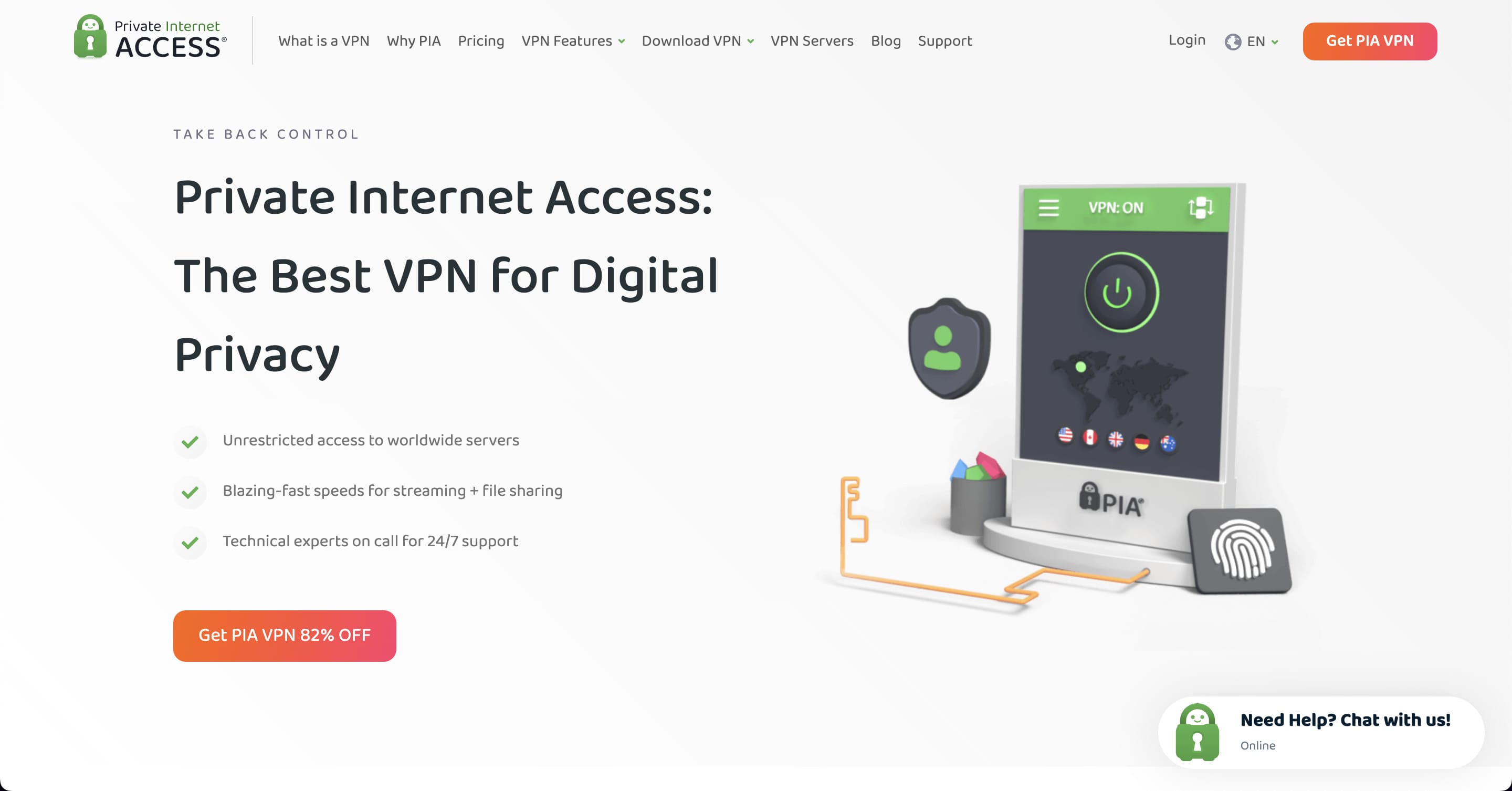
PIA places no limit on devices and publishes an Advanced Kill Switch, obfuscation, multi-hop and port forwarding. Its no-logs claim has been audited by Deloitte Audit Romania. The trade-off is jurisdiction: it operates from the United States, which some readers will rule out on principle. We list it because the rest of the record is strong and because it is one of only four providers with two or more cities in Japan.
| Private Internet Access | |
|---|---|
| Locations in this country | 2 cities |
| Countries covered | 104 of the 155 we count |
| Money-back window | 30 days |
| Operates under the law of | the United States |
| No-logs claim examined by | Deloitte (Deloitte Audit Romania) |
| Features the provider names | unlimited connections, PIA MACE ad and tracker blocking, Advanced Kill Switch, split tunnelling, multi-hop, obfuscation and port forwarding |
Frequently asked questions
Can I keep my US number and still use Japanese data?
On a phone that supports two lines at once, yes — that is the usual arrangement. The US line stays active for calls and messages while a Japanese plan carries data. Turn data roaming off on the US line so it does not quietly carry traffic as well.
Will a VPN stop roaming charges?
No. Charges are counted by the network you are attached to, and a tunnel does not change which network that is. A VPN changes where you appear to be, not what you are billed for.
Do I need a VPN at all if I have a Japanese plan?
Only for services that object to a Japanese address — typically banking, a government portal, or a subscription whose catalogue changes abroad. For Japanese sites you want the Japanese address, so leave it off.
Can I use a free VPN for this?
Usually not, and the reason is measurable rather than moral. Even on paid services we measured, between 10% and 60% of the raw line disappears into the tunnel — in Tokyo a 780 Mbps line came out at roughly half. Free tiers add a data cap and a much smaller server list on top of that. They also have to earn money somewhere, and where the product is free the revenue usually comes from the traffic itself.
Conclusion
Treat the number and the data as two decisions and most of the argument disappears. Keep the line for messages, buy data locally, turn data roaming off, and get the carrier's current prices from the carrier rather than from an article.
Then set up the part that is actually ours to measure: a provider with locations on both sides, installed and signed in before you leave.
Every figure on this page comes from our own daily collection or our own measurements. The files are published as open data under CC BY 4.0, and the method — including what the numbers do not prove — is on how we test.