Why Claude does not open in Hong KongNot a block — an absence from the list
Hong Kong is not on Anthropic's published list of supported countries and regions. That single fact decides everything else on this page — including why a Hong Kong VPN server is the one choice that cannot work.
If Claude refuses to load in Hong Kong, the instinct is to look for a fault at your end — the network, the browser, the account. In this case there is nothing at your end to find. Anthropic publishes a list of the countries and regions where Claude is offered, and Hong Kong is not on it.
That distinction matters, because it changes what the fix is. A network block is something you route around; an absence from a supported-regions list is something you have to arrive from somewhere else entirely. And it rules out the server that almost everyone reaches for first.
- Hong Kong is not on Anthropic's published list; Japan and Taiwan are
- We read the list item by item, with a control entry, rather than searching for a word
- A Hong Kong VPN server cannot help — Hong Kong is the region being refused
- All seven providers we track publish a Hong Kong location, which is why this trap is so easy to fall into
- Google's list for Gemini does include Hong Kong, so the answer does not carry between AI services
Hong Kong is not on Anthropic's supported list
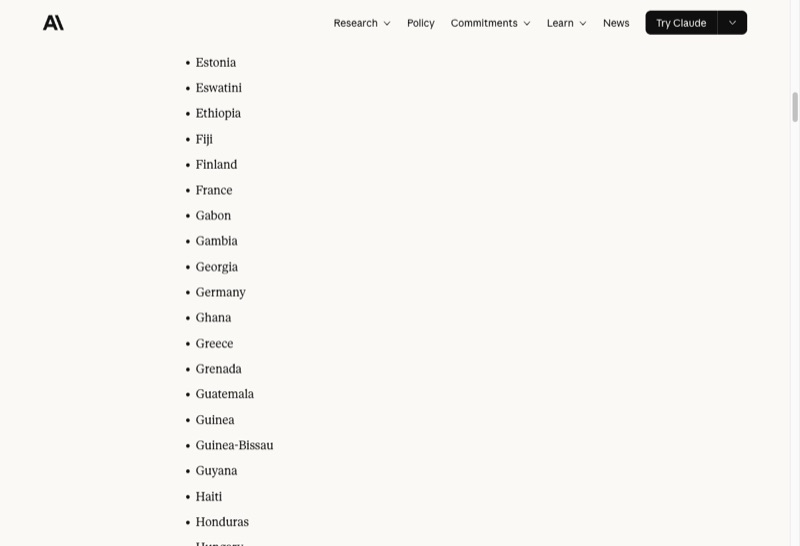
Anthropic publishes a page titled “Supported countries & regions”, and the page states that it covers both commercial API access and Claude.ai — one list for both. We opened it and counted 183 entries.
Hong Kong is not among them. Neither is Macau, and neither is mainland China. Taiwan, Japan, Singapore and South Korea all are.
The list this whole question turns on
How we checked it, and the control we used
Searching a long page for “Hong Kong” and finding nothing is weak evidence: it proves the search ran, not that the search was looking in the right place. So we extracted the entries themselves and compared them one at a time, and we included a control — an ordinary entry we expected to find.
Honduras is the control. If our comparison returns “Honduras: listed” and “Hong Kong: not listed” in the same pass, then the method is working and the absence is real rather than an artefact of how we read the page.
| Country or region | On Anthropic's published list |
|---|---|
| Hong Kong | Not listed |
| Macau | Not listed |
| Mainland China | Not listed |
| Taiwan | Listed |
| Japan | Listed |
| Singapore | Listed |
| South Korea | Listed |
| Honduras (our control) | Listed |
Read from Anthropic's own page by VPN LIFE on 20 September 2026, item by item rather than by searching the page for a word. The last row is a control: an entry we expected to find, included to show the comparison itself is working.
There is a second, sharper way to see it. Both lists are alphabetical, so the same neighbourhood appears in each — and Google's list for Gemini has Hong Kong sitting in exactly the place Anthropic's does not.
| List | What comes before | The entry in question | What comes after |
|---|---|---|---|
| Anthropic (Claude) | Haiti | Honduras | Hungary |
| Google (Gemini) | Honduras | Hong Kong | Hungary |
Both lists are alphabetical, so the same three-entry neighbourhood appears in each. Google's has Hong Kong in it; Anthropic's goes straight from Honduras to Hungary. Read by VPN LIFE on 20 September 2026.
Anthropic does not publish a reason for the omission, and we are not going to supply one. What is on the page is the list; what follows from the list is the rest of this article.
Why a Hong Kong VPN server is the one choice that cannot work
This is the part that costs people an afternoon. Every one of the seven providers we track publishes a location in Hong Kong — it is one of the best-covered places in Asia. So connecting to Hong Kong is easy, which is precisely why it is the first thing people try.
It cannot help. What Claude checks is where the connection is coming from, and Hong Kong is the answer that is being refused. Connecting from Hong Kong to a Hong Kong server means arriving as Hong Kong, which is where you started. The same applies to Macau and to mainland China: neither is on the list either.
| VPN | Locations in Hong Kong |
|---|---|
| ExpressVPN | 1 city |
| NordVPN | 1 city |
| Surfshark | 1 city |
| CyberGhost | 1 city |
| Private Internet Access | 1 city |
| Mullvad VPN | 1 city |
| Windscribe | 1 city |
Locations each provider publishes in its own server list, recounted daily by VPN LIFE. A published location is not a promise that a given server is reachable from where you are right now.
Read that table as a warning rather than a recommendation. Seven out of seven is the reason the mistake is so common, not a reason to make it.
Connect to Japan or Taiwan instead
Two places are both on Anthropic's list and close enough to Hong Kong for the route to stay short: Japan and Taiwan. Here is what the providers actually publish in each, counted this morning.
| VPN | Locations in Japan | Locations in Taiwan |
|---|---|---|
| ExpressVPN | 4 cities | 1 city |
| NordVPN | 2 cities | 1 city |
| Surfshark | 1 city | 1 city |
| CyberGhost | 1 city | 1 city |
| Private Internet Access | 2 cities | 2 cities |
| Mullvad VPN | 2 cities | Not listed |
| Windscribe | 1 city | 1 city |
Locations each provider publishes in its own server list, recounted daily by VPN LIFE. A published location is not a promise that a given server is reachable from where you are right now.
The column that matters is not the count of providers — both places are well covered — but the count of cities. When one address stops answering, the cheap fix is another address in the same country; that option only exists with a provider publishing two or more cities there. In Japan, four of the seven do. In Taiwan, one does.
Taiwan is the shorter hop from Hong Kong and is a reasonable second choice if Japan is unstable on your connection. Japan is the better first choice, because it gives you somewhere to go when the first server disappoints.
What you are trying to reach

How to reach Claude from Hong Kong, step by step
Step 1: install the app and sign in
Create the account on the provider's own site, then install its app on the device you will actually use. Sign in before you need it. Installation is a ten-minute job and it is the only part of this that cannot be rushed later.
Step 2: choose Japan or Taiwan by hand
Open the country list and pick Japan — do not leave the app on automatic selection. Automatic picks the fastest nearby server, and from Hong Kong the fastest nearby server is very often Hong Kong, which puts you back where you started.
Wait for the app to report the connection as established before doing anything else, and check the country on an address-checking page rather than trusting the app's own label.
Step 3: open Claude after the tunnel is up, not before
Order matters. A page opened before the connection was established can hold the earlier verdict, and the site's stored data can hold it longer still. Connect first, then open claude.ai in a fresh tab. If it still refuses, clear the site's stored data, then change city within Japan before changing provider.
- Connect first, open Claude second — never the other way round
- Verify the country on an address-checking page, not in the app's label
- Never select Hong Kong, Macau or mainland China
- If it fails, change city before you change provider
- The account's own country is a record, not an address — a VPN does not alter it
Speed is not what is stopping you, and we measured it
Every VPN site says a tunnel costs you speed. Almost none of them say how much. We measured it by hand rather than repeating a claim: 14 cities, 46 paired runs, comparing NordVPN and Surfshark against the same raw line in the same session. In the 11 cities where we also measured the bare line, the share that survived the tunnel ranged from 40% to 90%.
| City | Raw line | NordVPN | Surfshark | Paired runs |
|---|---|---|---|---|
| Tokyo | 780 Mbps | 444.9 Mbps (57%) | 399.9 Mbps (51%) | 9 |
| London | 790 Mbps | 712.6 Mbps (90%) | 713.5 Mbps (90%) | 9 |
| New York | 760 Mbps | 598.9 Mbps (79%) | 556.6 Mbps (73%) | 7 |
| Los Angeles | 530 Mbps | 358.8 Mbps (68%) | 305.8 Mbps (58%) | 5 |
Measured by VPN LIFE. Raw-line figures are rounded to the nearest 10 Mbps. Percentages are the share of the raw line that survived.
- 14 cities, 46 paired runs, measured by hand
- 11 of those cities also have the bare line measured
- 40% to 90% of the raw line survived
- We only name a winner in 4 cities — the rest have too few runs
The spread between cities is larger than the spread between providers. In London roughly nine tenths of the line survived on both services; in Tokyo it was closer to half. That is worth knowing before you blame the provider: "this VPN is slow" is usually "this route is slow".
We only call a winner in a city when we have five or more paired runs there and the gap is at least 10%. That threshold is met in 4 of the 14 cities — Tokyo and Los Angeles, where NordVPN averaged ahead, and London and New York, where the two were level. In the remaining ten cities we publish the numbers and say the sample is too small, rather than ranking on one run.
How much of the line survived the tunnel






The VPN providers we track, and what each publishes in Japan
We rank on what we can check. Each of the five below publishes a location in Japan; the tables are our own counts and the providers' own published terms, not a summary of their marketing.
ExpressVPN: the widest spread of cities
ExpressVPN

ExpressVPN publishes more multi-city countries than anyone else in our set — 11 countries where you can pick between two or more locations, including 56 in the United States, 7 in the United Kingdom, 6 in Australia and 4 in Japan. If your problem is a blocked address rather than a missing country, that spread is the thing that gets you out of it. It is the most expensive option here, and it is the one we would pick for streaming.
| ExpressVPN | |
|---|---|
| Locations in this country | 4 cities |
| Countries covered | 112 of the 155 we count |
| Money-back window | 30 days |
NordVPN: the largest country list, and the one we measured
NordVPN

NordVPN covers more countries than anything else we track. It is also one of the two services we measured ourselves, so the retention figures above are its actual numbers rather than a claim. It operates from Panama, has been audited by Deloitte, allows 10 simultaneous connections, and lists obfuscated servers and a kill switch among its features — the two things that matter where VPN traffic is filtered.
| NordVPN | |
|---|---|
| Locations in this country | 2 cities |
| Countries covered | 150 of the 155 we count |
| Money-back window | 30 days |
| Operates under the law of | Panama |
| No-logs claim examined by | Deloitte |
| Features the provider names | Threat Protection, Double VPN, obfuscated servers, Meshnet, dedicated IP, kill switch and split tunnelling |
Surfshark: unlimited devices, and level with NordVPN in half our tests
Surfshark

Surfshark is the other service in our own measurements. In London and New York it was level with NordVPN; in Tokyo and Los Angeles it trailed by 11% and 17%. It places no limit on simultaneous connections, which makes it the sensible choice for a household rather than a person. Audited by Deloitte, operating from the Netherlands, with Camouflage Mode for networks that filter VPN traffic.
| Surfshark | |
|---|---|
| Locations in this country | 1 city |
| Countries covered | 100 of the 155 we count |
| Money-back window | 30 days |
| Operates under the law of | the Netherlands |
| No-logs claim examined by | Deloitte |
| Features the provider names | CleanWeb, Dynamic MultiHop, rotating IP, Camouflage Mode, kill switch and split tunnelling (Bypasser) |
CyberGhost: the longest money-back window, with a catch
CyberGhost
CyberGhost's 45-day money-back guarantee is the longest here, and it is the reason it appears on most lists. Read the condition: 45 days applies to the six-month and two-year plans, and the monthly plan gets 14 days. It publishes 10 multi-city countries, with 11 locations in the United States, but only a single city in Japan — so it is a weaker choice if Japanese services are your target.
| CyberGhost | |
|---|---|
| Locations in this country | 1 city |
| Countries covered | 100 of the 155 we count |
| Money-back window | 45 days (six-month and two-year plans; 14 days on monthly) |
Private Internet Access: unlimited connections, US jurisdiction
Private Internet Access
PIA places no limit on devices and publishes an Advanced Kill Switch, obfuscation, multi-hop and port forwarding. Its no-logs claim has been audited by Deloitte Audit Romania. The trade-off is jurisdiction: it operates from the United States, which some readers will rule out on principle. We list it because the rest of the record is strong and because it is one of only four providers with two or more cities in Japan.
| Private Internet Access | |
|---|---|
| Locations in this country | 2 cities |
| Countries covered | 92 of the 155 we count |
| Money-back window | 30 days |
| Operates under the law of | the United States |
| No-logs claim examined by | Deloitte (Deloitte Audit Romania) |
| Features the provider names | unlimited connections, PIA MACE ad and tracker blocking, Advanced Kill Switch, split tunnelling, multi-hop, obfuscation and port forwarding |
Frequently asked questions
Is Claude blocked in Hong Kong by the authorities?
That is not what our check shows. The observable fact is that Hong Kong does not appear on Anthropic's own published list of supported countries and regions, alongside Macau and mainland China — while Taiwan, Japan, Singapore and South Korea do. That is a decision on the service's side rather than a property of your connection.
Will a Hong Kong VPN server work?
No, and it is the most common wasted attempt. Hong Kong is the region that is not on the list, so arriving from a Hong Kong address changes nothing. Choose Japan or Taiwan; both are on the list.
Does this apply to the Claude API as well as Claude.ai?
Anthropic's page says it covers commercial API access and Claude.ai, and it publishes one list for both. So the same regions apply.
Why is Taiwan supported when Hong Kong is not?
Anthropic does not publish a reason, and we did not find one on the page. We would rather leave that blank than guess at it. What we can show is the list itself, which we read entry by entry on 20 September 2026.
Is the answer the same for Gemini?
No — this is the one place where the services genuinely diverge. Google's published list for the Gemini web app includes Hong Kong, Macau and Taiwan with no qualifier attached, and mainland China with one. Anthropic's list has none of the first three. We set the two side by side on our page about Gemini in China.
Will it slow my connection down?
Yes, and we have measured how much: across 14 cities and 46 paired runs, between 40% and 90% of the raw line survived the tunnel. The variation between cities is wider than the variation between providers — London kept about 90% on both services we tested, Tokyo about half. If a VPN feels slow, the route is a more likely explanation than the provider.
Can I use a free VPN for this?
Usually not, and the reason is measurable rather than moral. Even on paid services we measured, between 10% and 60% of the raw line disappears into the tunnel — in Tokyo a 780 Mbps line came out at roughly half. Free tiers add a data cap and a much smaller server list on top of that. They also have to earn money somewhere, and where the product is free the revenue usually comes from the traffic itself.
What else is a VPN good for?
The everyday case is public Wi-Fi, where the network operator would otherwise see every site you connect to. The other common ones are reaching services from home while travelling — banks and government portals refuse foreign addresses constantly — and comparing prices that vary by country. We publish the underlying server and speed data for all of it on our open data page.
Conclusion
Hong Kong is not on Anthropic's list, and no amount of reconnecting changes that. Japan and Taiwan are on it, and every provider we track publishes a location in both.
Pick Japan first if you want a second city to fall back on, Taiwan if you want the shortest hop. And do not spend the afternoon on a Hong Kong server: it is the one destination that is guaranteed not to help.
Every count on this page is our own: the two official lists were read item by item on 20 September 2026, and the provider locations are recollected every day. The files are published as open data under CC BY 4.0, and the method — including what the numbers do not prove — is on how we test.