How to reach Gemini from mainland ChinaOn the list, with one qualifier attached
Mainland China is on Google's list for Gemini. It is also the only entry on that list whose availability is qualified — and the qualifier is the whole story.
Gemini does not open on an ordinary connection in mainland China, and the reason is not the one people expect. Google's own published list of countries and territories for the Gemini web app does include mainland China — unlike Anthropic's list for Claude, which does not.
What makes the entry different is what is written after it. Of the 242 entries in that list, exactly one has a qualifier attached to its availability, and it is this one: “Mainland China (Workspace only)”. Everything useful on this page follows from reading that carefully rather than around it.
- Mainland China is on Google's list — as “Mainland China (Workspace only)”
- It is the only entry of 242 whose availability carries a qualifier
- Hong Kong, Macau, Taiwan and Japan are all listed with no qualifier at all
- That is the opposite of Anthropic's list for Claude, which has none of the first three
- The mobile app has its own, shorter list — and mainland China is not on it at all
- Only 3 of the 7 providers we track publish any location in mainland China
What Google's list actually says
Google publishes a help page listing the languages and the countries and territories where the Gemini web app is available. The page says it is available in more than 70 languages and over 230 countries and territories. We read the country list on 20 September 2026 and counted 242 entries.
| Country or region | On Google's published list |
|---|---|
| Mainland China | Listed, as “Mainland China (Workspace only)” |
| Hong Kong | Listed, with no qualifier |
| Macau | Listed, with no qualifier |
| Taiwan | Listed, with no qualifier |
| Japan | Listed, with no qualifier |
Read from Google's own page by VPN LIFE on 20 September 2026, item by item rather than by searching the page for a word. One page carries both the language list and the country list. We separated the two and compared entries from the country list only.
Where the qualifier actually appears
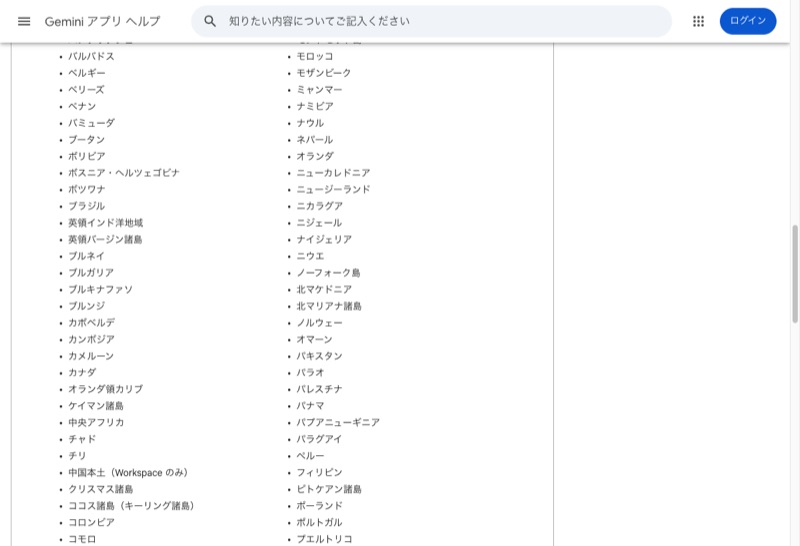
The trap on this page, and how we avoided it
The language list and the country list live on the same page, and searching the text for a place name will find the wrong one. “Chinese (Simplified/Traditional/Hong Kong)” is an entry in the language list — read it as a country and you will conclude something false about Hong Kong.
So we extracted the entries and split them into the two blocks before comparing anything: the language block ends at Zulu, and the country block runs from Åland Islands to Zimbabwe. Every statement on this page refers to the country block.
Only one entry in 242 is qualified
Three of the 242 country entries contain brackets. Two of them are simply part of the place name — Cocos (Keeling) Islands and Falkland Islands (Islas Malvinas). The third is “Mainland China (Workspace only)”, and it is the only entry on the list where the brackets say something about who can use the service rather than what the place is called.
That is the finding. It is not that mainland China is missing; it is that mainland China is the single conditional entry on an otherwise unconditional list.
How to read “Workspace only”
Google Workspace is the account type organisations buy — the accounts issued by an employer or a school, as distinct from a personal Google account. The qualifier on the list separates those two, and it separates them for exactly one territory.
We will say plainly what we have and have not established. We have read the page and can show you what it says about each entry. We have not tested Gemini from inside mainland China on either account type, so we are not going to tell you what a personal account does there. The verifiable part is the list, and on the list mainland China is the one conditional entry.
The web app and the mobile app have different lists
Google publishes the availability of the Gemini web app and the Gemini mobile app on two separate help pages, and the two lists do not agree. We read both on 20 September 2026.
The web page claims over 230 countries and territories; we counted 242 entries. The mobile page claims more than 150 countries; we counted 205. And mainland China, which appears on the web list with its qualifier, does not appear on the mobile list at all — not qualified, not present.
| Gemini web app | Gemini mobile app | |
|---|---|---|
| What the page claims | “over 230 countries and territories” | “more than 150 countries” |
| Entries we counted | 242 | 205 |
| Mainland China | Listed, as “Mainland China (Workspace only)” | Not listed at all |
| Hong Kong | Listed | Listed |
| Macau | Listed | Listed |
| Taiwan | Listed | Listed |
| Japan | Listed | Listed |
Two separate Google help pages, both read by VPN LIFE on 20 September 2026. Google does not explain the difference between them, and neither do we — what we can show is that the difference is there.
This matters for how you describe your own problem. “Gemini will not open on my phone” and “Gemini will not open in my browser” are not the same sentence, because the two are governed by different published lists. Establish which one you are testing before you change anything else — otherwise you are diagnosing two things at once.
Google does not say why the lists differ, so neither will we. The checkable part is that they do, and that mainland China is the entry they differ over.
Claude and Gemini give opposite answers about Hong Kong
Most articles treat “AI services in China” as one question with one answer. It is not. We read both companies' lists on the same day, and they disagree about the two places a traveller is most likely to connect through.
| Country or region | Google's Gemini list | Anthropic's Claude list |
|---|---|---|
| Mainland China | Listed, “Workspace only” | Not listed |
| Hong Kong | Listed | Not listed |
| Macau | Listed | Not listed |
| Taiwan | Listed | Listed |
| Japan | Listed | Listed |
Both pages read by VPN LIFE on the same day, 20 September 2026. The two lists disagree about Hong Kong and Macau, which is why one answer cannot be carried over to the other service.
Hong Kong is the clearest case. Google lists it with no qualifier; Anthropic's list does not contain it at all. So “connect to Hong Kong” is sound advice for Gemini and is the one thing guaranteed not to work for Claude. Macau splits the same way. We set out the Claude side on why Claude does not open in Hong Kong and how to reach Claude from mainland China.
The practical consequence: carry the answer per service, not per country. A setup that works for one of these two can fail for the other with the same server selected.
Where to connect, and why not mainland China itself
A server inside mainland China is on the same side of the country's traffic filtering that you are, so it is not a route out. It is also barely available: here is what the seven providers we track publish across the region.
| Country or region | Providers publishing a location | Providers with two or more cities |
|---|---|---|
| Mainland China | 3 of 7 | Every one publishes a single city |
| Hong Kong | 7 of 7 | Every one publishes a single city |
| Macau | 4 of 7 | Every one publishes a single city |
| Japan | 7 of 7 | ExpressVPN, NordVPN, Private Internet Access, Mullvad VPN |
| Taiwan | 6 of 7 | Private Internet Access |
| Singapore | 7 of 7 | ExpressVPN, Private Internet Access |
| South Korea | 6 of 7 | Private Internet Access |
Counted by VPN LIFE from each provider's own published server list, recollected every day.
Mainland China is the thinnest row by a wide margin and its neighbours are among the best covered places anywhere. For Gemini, unusually, most of those neighbours are also unqualified entries on Google's list — Hong Kong, Macau, Taiwan and Japan all are. That gives you more room than Claude does.
Japan first, with Hong Kong and Taiwan as fallbacks
Japan is the exit we would take first: an unqualified entry on Google's list, a short route, and more cities behind it than anywhere else nearby.
| VPN | Locations in Japan | Locations in Hong Kong |
|---|---|---|
| ExpressVPN | 4 cities | 1 city |
| NordVPN | 2 cities | 1 city |
| Surfshark | 1 city | 1 city |
| CyberGhost | 1 city | 1 city |
| Private Internet Access | 2 cities | 1 city |
| Mullvad VPN | 2 cities | 1 city |
| Windscribe | 1 city | 1 city |
Locations each provider publishes in its own server list, recounted daily by VPN LIFE. A published location is not a promise that a given server is reachable from where you are right now.
Cities are the column to read. When an address stops answering, changing city within the same country is the cheapest fix available, and it only exists where a provider publishes two or more. Four of the seven do in Japan; in Hong Kong all seven publish exactly one.
What you are trying to reach
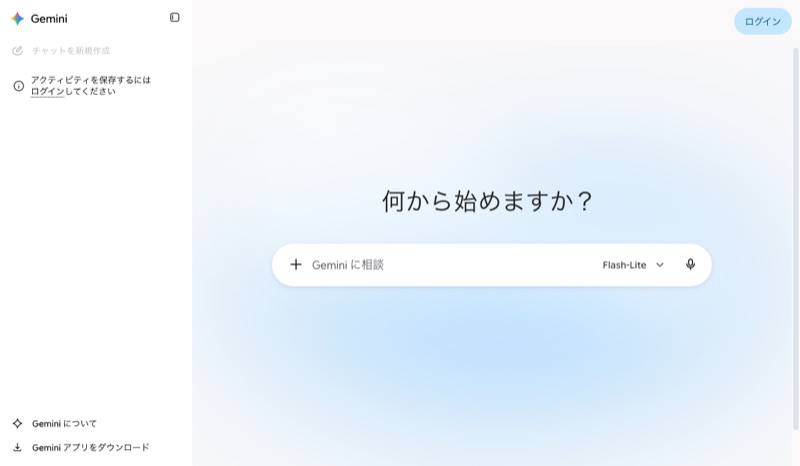
How to reach Gemini from mainland China, step by step
Step 1: subscribe and install before you travel
Provider sites are themselves hard to reach from inside the country, so the sign-up and the download have to happen while you still have an open connection. This is the most common failure on this whole page, and it happens before departure rather than after.
Step 2: connect to Japan by hand
Pick Japan from the country list rather than leaving the app on automatic selection, and wait for the connection to report as established. Then verify the country on an address-checking page instead of trusting the app's own label.
Step 3: open Gemini after the tunnel is up
Connect first, open Gemini second. A page opened beforehand can hold the earlier verdict, and so can the site's stored data. If it still refuses, clear that data and change city within Japan before changing provider.
- Subscribe, install and sign in before departure
- Choose the country by hand; automatic selection lands wherever is nearest
- Verify the address on a checking page, not in the app
- Connect first, open Gemini second
- Change city before you change provider
- Test the whole path before you fly — a subscription is not a verified connection
Speed is not the constraint here, and we measured it
Every VPN site says a tunnel costs you speed. Almost none of them say how much. We measured it by hand rather than repeating a claim: 14 cities, 46 paired runs, comparing NordVPN and Surfshark against the same raw line in the same session. In the 11 cities where we also measured the bare line, the share that survived the tunnel ranged from 40% to 90%.
| City | Raw line | NordVPN | Surfshark | Paired runs |
|---|---|---|---|---|
| Tokyo | 780 Mbps | 444.9 Mbps (57%) | 399.9 Mbps (51%) | 9 |
| London | 790 Mbps | 712.6 Mbps (90%) | 713.5 Mbps (90%) | 9 |
| New York | 760 Mbps | 598.9 Mbps (79%) | 556.6 Mbps (73%) | 7 |
| Los Angeles | 530 Mbps | 358.8 Mbps (68%) | 305.8 Mbps (58%) | 5 |
Measured by VPN LIFE. Raw-line figures are rounded to the nearest 10 Mbps. Percentages are the share of the raw line that survived.
- 14 cities, 46 paired runs, measured by hand
- 11 of those cities also have the bare line measured
- 40% to 90% of the raw line survived
- We only name a winner in 4 cities — the rest have too few runs
The spread between cities is larger than the spread between providers. In London roughly nine tenths of the line survived on both services; in Tokyo it was closer to half. That is worth knowing before you blame the provider: "this VPN is slow" is usually "this route is slow".
We only call a winner in a city when we have five or more paired runs there and the gap is at least 10%. That threshold is met in 4 of the 14 cities — Tokyo and Los Angeles, where NordVPN averaged ahead, and London and New York, where the two were level. In the remaining ten cities we publish the numbers and say the sample is too small, rather than ranking on one run.
How much of the line survived the tunnel






The VPN providers we track, and what each publishes in Japan
We rank on what we can check. Each of the five below publishes a location in Japan; the tables are our own counts and the providers' own published terms, not a summary of their marketing.
ExpressVPN: the widest spread of cities
ExpressVPN publishes more multi-city countries than anyone else in our set — 11 countries where you can pick between two or more locations, including 56 in the United States, 7 in the United Kingdom, 6 in Australia and 4 in Japan. If your problem is a blocked address rather than a missing country, that spread is the thing that gets you out of it. It is the most expensive option here, and it is the one we would pick for streaming.
| ExpressVPN | |
|---|---|
| Locations in this country | 4 cities |
| Countries covered | 112 of the 155 we count |
| Money-back window | 30 days |
ExpressVPN in use

NordVPN: the largest country list, and the one we measured
NordVPN covers more countries than anything else we track. It is also one of the two services we measured ourselves, so the retention figures above are its actual numbers rather than a claim. It operates from Panama, has been audited by Deloitte, allows 10 simultaneous connections, and lists obfuscated servers and a kill switch among its features — the two things that matter where VPN traffic is filtered.
| NordVPN | |
|---|---|
| Locations in this country | 2 cities |
| Countries covered | 150 of the 155 we count |
| Money-back window | 30 days |
| Operates under the law of | Panama |
| No-logs claim examined by | Deloitte |
| Features the provider names | Threat Protection, Double VPN, obfuscated servers, Meshnet, dedicated IP, kill switch and split tunnelling |
NordVPN in use
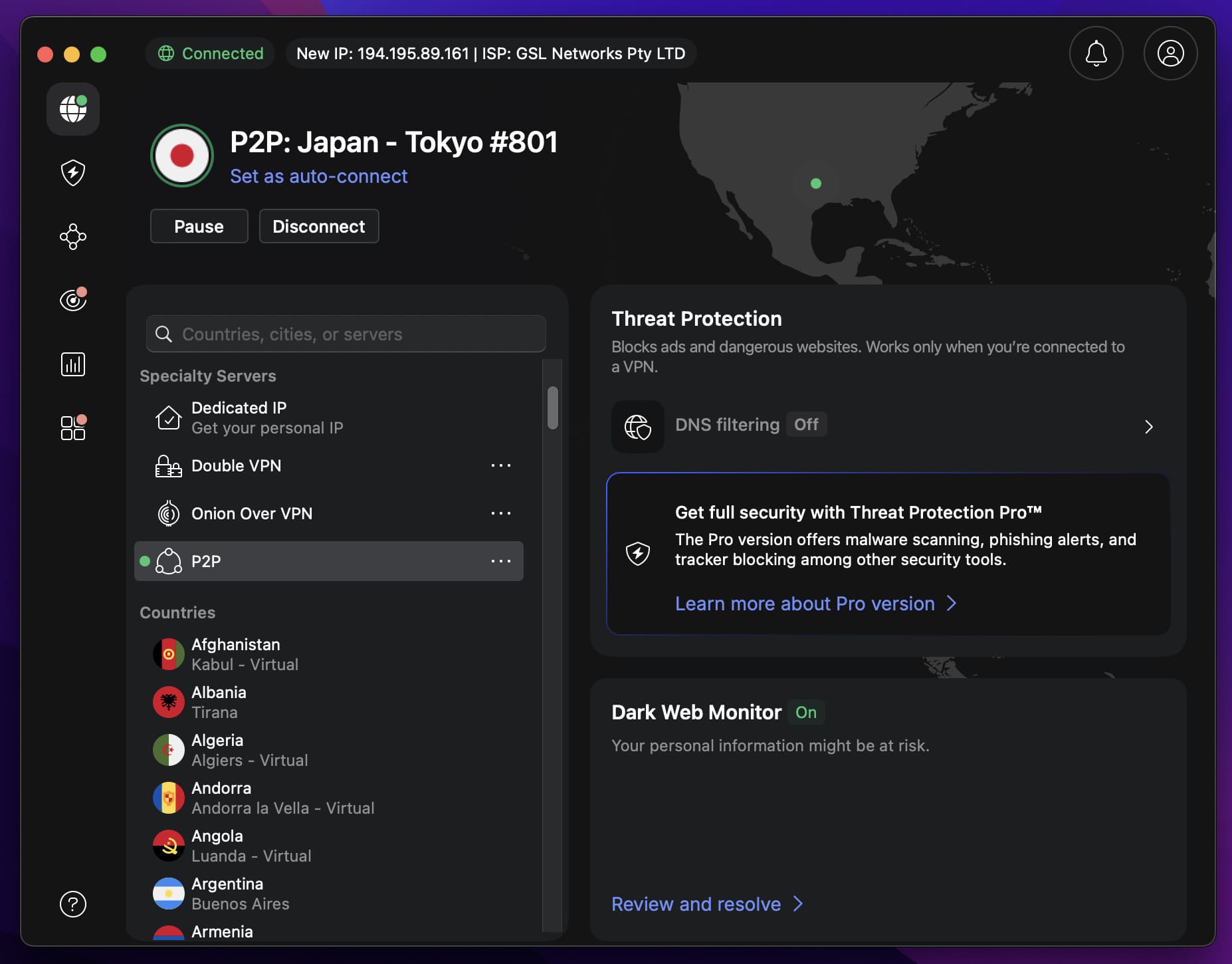
Surfshark: unlimited devices, and level with NordVPN in half our tests
Surfshark is the other service in our own measurements. In London and New York it was level with NordVPN; in Tokyo and Los Angeles it trailed by 11% and 17%. It places no limit on simultaneous connections, which makes it the sensible choice for a household rather than a person. Audited by Deloitte, operating from the Netherlands, with Camouflage Mode for networks that filter VPN traffic.
| Surfshark | |
|---|---|
| Locations in this country | 1 city |
| Countries covered | 100 of the 155 we count |
| Money-back window | 30 days |
| Operates under the law of | the Netherlands |
| No-logs claim examined by | Deloitte |
| Features the provider names | CleanWeb, Dynamic MultiHop, rotating IP, Camouflage Mode, kill switch and split tunnelling (Bypasser) |
Surfshark in use
CyberGhost: the longest money-back window, with a catch
CyberGhost's 45-day money-back guarantee is the longest here, and it is the reason it appears on most lists. Read the condition: 45 days applies to the six-month and two-year plans, and the monthly plan gets 14 days. It publishes 10 multi-city countries, with 11 locations in the United States, but only a single city in Japan — so it is a weaker choice if Japanese services are your target.
| CyberGhost | |
|---|---|
| Locations in this country | 1 city |
| Countries covered | 100 of the 155 we count |
| Money-back window | 45 days (six-month and two-year plans; 14 days on monthly) |
CyberGhost in use
Private Internet Access: unlimited connections, US jurisdiction
PIA places no limit on devices and publishes an Advanced Kill Switch, obfuscation, multi-hop and port forwarding. Its no-logs claim has been audited by Deloitte Audit Romania. The trade-off is jurisdiction: it operates from the United States, which some readers will rule out on principle. We list it because the rest of the record is strong and because it is one of only four providers with two or more cities in Japan.
| Private Internet Access | |
|---|---|
| Locations in this country | 2 cities |
| Countries covered | 92 of the 155 we count |
| Money-back window | 30 days |
| Operates under the law of | the United States |
| No-logs claim examined by | Deloitte (Deloitte Audit Romania) |
| Features the provider names | unlimited connections, PIA MACE ad and tracker blocking, Advanced Kill Switch, split tunnelling, multi-hop, obfuscation and port forwarding |
Private Internet Access in use

Frequently asked questions
Mainland China is on the list, so why does Gemini not open?
The entry reads “Mainland China (Workspace only)”, and it is the only entry of 242 whose availability is qualified that way. Workspace accounts are the ones issued by an organisation rather than personal Google accounts. We have read the page and can show you what it says; we have not tested either account type from inside the country, so that is where our evidence stops.
Will a Hong Kong server work for Gemini?
Google lists Hong Kong with no qualifier, alongside Macau, Taiwan and Japan, so it is a legitimate choice for Gemini. Note that this is the opposite of the answer for Claude, whose list contains none of Hong Kong, Macau or mainland China.
Is there a difference between the phone app and the browser?
Yes, and it is published rather than anecdotal. Google lists availability for the web app and the mobile app on two separate help pages. Mainland China appears on the web list with the “Workspace only” qualifier and does not appear on the mobile list at all. Hong Kong, Macau, Taiwan and Japan are on both. So say which one you are testing before you compare notes with anyone.
Is it legal to use a VPN in China?
Regulations dating from 1996 prohibit connecting to the international internet other than through government-approved channels, and the text covers individuals as well as organisations. The penalties set out are administrative rather than criminal — warnings, suspension of the connection, and a fine of up to 15,000 yuan. Reported enforcement has concentrated on people selling or supplying access. This is not legal advice.
Does the Gemini API use the same list?
What we read and counted is the help page for the Gemini web app. Google documents the developer API separately, and we have not cross-checked that page, so treat everything here as being about the web app.
Should I look for a VPN with servers in China?
No. A server inside mainland China is on the same side of the filtering you are on, so it is not a route out — and only 3 of the 7 providers we track publish any location there at all.
Can I use a free VPN for this?
Usually not, and the reason is measurable rather than moral. Even on paid services we measured, between 10% and 60% of the raw line disappears into the tunnel — in Tokyo a 780 Mbps line came out at roughly half. Free tiers add a data cap and a much smaller server list on top of that. They also have to earn money somewhere, and where the product is free the revenue usually comes from the traffic itself.
Will it slow my connection down?
Yes, and we have measured how much: across 14 cities and 46 paired runs, between 40% and 90% of the raw line survived the tunnel. The variation between cities is wider than the variation between providers — London kept about 90% on both services we tested, Tokyo about half. If a VPN feels slow, the route is a more likely explanation than the provider.
What is a VPN, in one paragraph?
A VPN is an encrypted connection between your device and a server run by the provider. Everything you send goes through that tunnel, so the network you are sitting on sees only an encrypted link to one address, and the sites you open see the server's address rather than yours. That is the entire mechanism; the differences between providers are about where the servers are, how fast the route is, and what the provider keeps.
Conclusion
Mainland China is on Google's list for Gemini, and it is the only one of 242 entries with a condition attached. Hong Kong, Macau, Taiwan and Japan carry none.
Connect to Japan first for the cities behind it, and keep Hong Kong and Taiwan as fallbacks — remembering that for Claude those two fallbacks do not exist, and that the mobile app is governed by a different list again.
Every count on this page is our own: the two official lists were read item by item on 20 September 2026, and the provider locations are recollected every day. The files are published as open data under CC BY 4.0, and the method — including what the numbers do not prove — is on how we test.