Best VPN for Australia7 of 7 providers have servers there
7 of the seven VPN providers we track publish a server location in Australia. We recount that every day from the providers' own lists, and we measured the speed ourselves rather than repeating a claim.

Choosing a VPN for Australia comes down to two questions that most comparison articles skip: does the provider actually have servers in Australia, and how much of your connection survives the tunnel. We answer the first by reading each provider's own published server list every day, and the second by running paired speed tests by hand.
Here is where that leaves things for Australia today. 7 of the seven providers we track publish at least one location in Australia, between them listing 31 locations.
Connecting to a server in Australia

Why a Australia server changes the result
| VPN | Locations in Australia | Locations in Japan |
|---|---|---|
| ExpressVPN | 6 cities | 4 cities |
| NordVPN | 5 cities | 2 cities |
| Surfshark | 5 cities | 1 city |
| CyberGhost | 3 cities | 1 city |
| Private Internet Access | 6 cities | 2 cities |
| Mullvad VPN | 5 cities | 2 cities |
| Windscribe | 1 city | 1 city |
Locations each provider publishes in its own server list, recounted daily by VPN LIFE. A published location is not a promise that a given server is reachable from where you are right now.
How many locations each provider has in Australia
Australia next to its neighbours
What is actually different here
Australia's own services — 9Now, 10 play, SBS On Demand, Stan — are firmly geo-fenced, and the country's distance from most server locations makes latency a real consideration rather than a theoretical one. A provider with an Australian location will always beat a faster provider without one.
Data-retention obligations on domestic carriers are the usual reason Australians cite for using a VPN at home, distinct from the streaming case.
Tips to Choose the Best VPN for Australia
- 7 of 7 providers we track publish a location in Australia
- 6 of them publish more than one city there — that is your fallback when an address gets blocked
- 5 of 7 name the outside firm that examined their no-logs claim
- 7 to 45 days is the range of money-back windows, and CyberGhost's 45 does not apply to the monthly plan
- 40% to 90% of a raw line survived the tunnel in our own measurements
Most VPN comparisons rank providers on a server total and a headline price. Neither number tells you whether the service will work where you are. We collect two things that do, every day: how many locations each provider publishes in Australia specifically, and how much of a real connection survives the tunnel. Here is what we suggest you check, and what our own collection says about each point.
| What to check | What our data says for Australia | Why it matters |
|---|---|---|
| Servers in the country you need | 7 of the 7 providers we track publish a location in Australia | Counted daily from each provider's own server list |
| More than one city there | 6 of those 7 publish two or more cities | A second address to move to when the first is blocked |
| Money-back window | 7 to 45 days depending on the provider | Read from each provider's own pricing page |
| Independent audit of the no-logs claim | 5 of the 7 name an outside auditor | The auditor's name, not just the word "audited" |
| Jurisdiction | 5 of the 7 state the country they operate under | Decides how a disclosure request is handled |
Collected by VPN LIFE from each provider's public server list and pricing page. The full files are on our open data page.
Servers in the country you actually need
A provider can advertise ninety countries and still not cover yours. What matters is the row for Australia. Of the seven providers we track, 7 publish at least one location in Australia, and together they list 31 locations there. That single number decides whether the provider is a candidate at all — everything else is secondary to it.
We recount this every day rather than quoting a marketing page, because providers add and drop locations quietly. A country that had four providers last quarter can have two now, and the provider's own comparison table will not tell you.
More than one city in that country
This is the check almost nobody makes, and it is the one that decides whether you are stuck when something goes wrong. Streaming services and banks block addresses they recognise. If your provider has a single location in Australia and that address is on a blocklist, you have no move left except changing provider or waiting for them to rotate the range. 6 of the providers covering Australia publish two or more cities: ExpressVPN (6), NordVPN (5), Surfshark (5), CyberGhost (3), Private Internet Access (6), Mullvad VPN (5).
Security you can verify, not adjectives
"Military-grade encryption" appears on every VPN site and means nothing on its own. Two claims can actually be checked. The first is the no-logs audit: five of the seven providers we track name the firm that examined them — Deloitte for NordVPN, Surfshark and Private Internet Access; Packetlabs and Leviathan Security Group for Windscribe; and six separate organisations for Mullvad. The second is jurisdiction, because how a provider answers a legal demand depends on the law it operates under: Panama, the Netherlands, Sweden, the United States and Canada respectively.
Support, and a way out if it does not work
Every provider we track offers a money-back window, and the length varies more than people expect: 30 days for NordVPN, Surfshark and Private Internet Access, 14 for Mullvad, 7 for Windscribe, and 45 for CyberGhost — though CyberGhost's 45 days applies to the six-month and two-year plans only, and the monthly plan gets 14. That caveat is missing from most comparison articles, including, until recently, our own Japanese pages. It matters: if you sign up monthly expecting 45 days, you miss the deadline by a month.






Best VPN Services for Australia
We rank on what we can check. Each of the five below publishes a location in Australia; the tables are our own counts and the providers' own published terms, not a summary of their marketing.
ExpressVPN: the widest spread of cities
ExpressVPN

ExpressVPN publishes more multi-city countries than anyone else in our set — 11 countries where you can pick between two or more locations, including 56 in the United States, 7 in the United Kingdom, 6 in Australia and 4 in Japan. If your problem is a blocked address rather than a missing country, that spread is the thing that gets you out of it. It is the most expensive option here, and it is the one we would pick for streaming.
| ExpressVPN | |
|---|---|
| Locations in this country | 6 cities |
| Countries covered | 112 of the 155 we count |
| Money-back window | 30 days |
NordVPN: the largest country list, and the one we measured
NordVPN

NordVPN covers more countries than anything else we track. It is also one of the two services we measured ourselves, so the retention figures above are its actual numbers rather than a claim. It operates from Panama, has been audited by Deloitte, allows 10 simultaneous connections, and lists obfuscated servers and a kill switch among its features — the two things that matter where VPN traffic is filtered.
| NordVPN | |
|---|---|
| Locations in this country | 5 cities |
| Countries covered | 150 of the 155 we count |
| Money-back window | 30 days |
| Operates under the law of | Panama |
| No-logs claim examined by | Deloitte |
| Features the provider names | Threat Protection, Double VPN, obfuscated servers, Meshnet, dedicated IP, kill switch and split tunnelling |
Surfshark: unlimited devices, and level with NordVPN in half our tests
Surfshark

Surfshark is the other service in our own measurements. In London and New York it was level with NordVPN; in Tokyo and Los Angeles it trailed by 11% and 17%. It places no limit on simultaneous connections, which makes it the sensible choice for a household rather than a person. Audited by Deloitte, operating from the Netherlands, with Camouflage Mode for networks that filter VPN traffic.
| Surfshark | |
|---|---|
| Locations in this country | 5 cities |
| Countries covered | 100 of the 155 we count |
| Money-back window | 30 days |
| Operates under the law of | the Netherlands |
| No-logs claim examined by | Deloitte |
| Features the provider names | CleanWeb, Dynamic MultiHop, rotating IP, Camouflage Mode, kill switch and split tunnelling (Bypasser) |
CyberGhost: the longest money-back window, with a catch
CyberGhost
CyberGhost's 45-day money-back guarantee is the longest here, and it is the reason it appears on most lists. Read the condition: 45 days applies to the six-month and two-year plans, and the monthly plan gets 14 days. It publishes 10 multi-city countries, with 11 locations in the United States, but only a single city in Japan — so it is a weaker choice if Japanese services are your target.
| CyberGhost | |
|---|---|
| Locations in this country | 3 cities |
| Countries covered | 100 of the 155 we count |
| Money-back window | 45 days (six-month and two-year plans; 14 days on monthly) |
Private Internet Access: unlimited connections, US jurisdiction
Private Internet Access
PIA places no limit on devices and publishes an Advanced Kill Switch, obfuscation, multi-hop and port forwarding. Its no-logs claim has been audited by Deloitte Audit Romania. The trade-off is jurisdiction: it operates from the United States, which some readers will rule out on principle. We list it because the rest of the record is strong and because it is one of only four providers with two or more cities in Japan.
| Private Internet Access | |
|---|---|
| Locations in this country | 6 cities |
| Countries covered | 104 of the 155 we count |
| Money-back window | 30 days |
| Operates under the law of | the United States |
| No-logs claim examined by | Deloitte (Deloitte Audit Romania) |
| Features the provider names | unlimited connections, PIA MACE ad and tracker blocking, Advanced Kill Switch, split tunnelling, multi-hop, obfuscation and port forwarding |
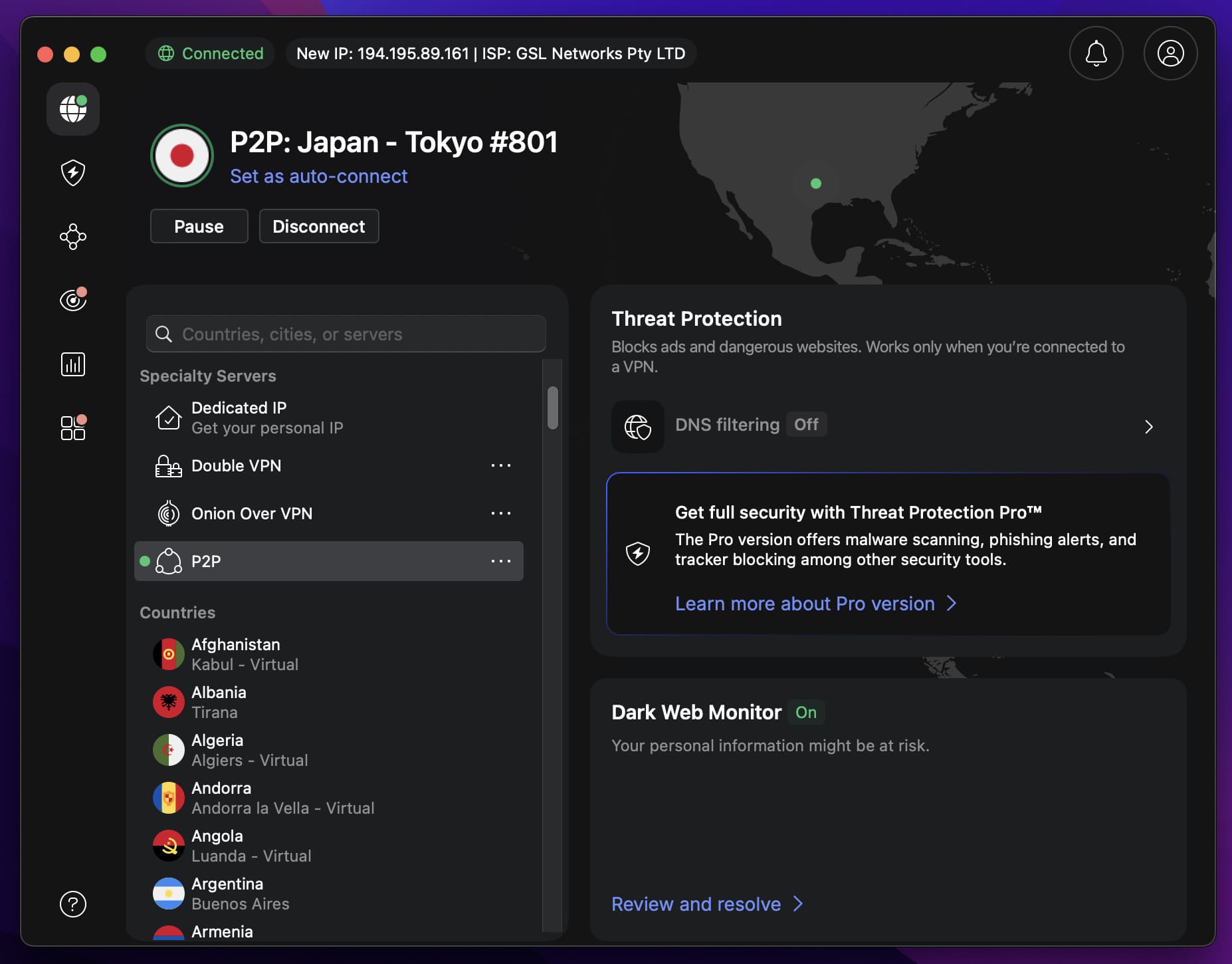
The app you will actually use
How much speed actually survives the tunnel
Every VPN site says a tunnel costs you speed. Almost none of them say how much. We measured it by hand rather than repeating a claim: 14 cities, 46 paired runs, comparing NordVPN and Surfshark against the same raw line in the same session. In the 11 cities where we also measured the bare line, the share that survived the tunnel ranged from 40% to 90%.
| City | Raw line | NordVPN | Surfshark | Paired runs |
|---|---|---|---|---|
| Tokyo | 780 Mbps | 444.9 Mbps (57%) | 399.9 Mbps (51%) | 9 |
| London | 790 Mbps | 712.6 Mbps (90%) | 713.5 Mbps (90%) | 9 |
| New York | 760 Mbps | 598.9 Mbps (79%) | 556.6 Mbps (73%) | 7 |
| Los Angeles | 530 Mbps | 358.8 Mbps (68%) | 305.8 Mbps (58%) | 5 |
Measured by VPN LIFE. Raw-line figures are rounded to the nearest 10 Mbps. Percentages are the share of the raw line that survived.
- 14 cities, 46 paired runs, measured by hand
- 11 of those cities also have the bare line measured
- 40% to 90% of the raw line survived
- We only name a winner in 4 cities — the rest have too few runs
The spread between cities is larger than the spread between providers. In London roughly nine tenths of the line survived on both services; in Tokyo it was closer to half. That is worth knowing before you blame the provider: "this VPN is slow" is usually "this route is slow".
We only call a winner in a city when we have five or more paired runs there and the gap is at least 10%. That threshold is met in 4 of the 14 cities — Tokyo and Los Angeles, where NordVPN averaged ahead, and London and New York, where the two were level. In the remaining ten cities we publish the numbers and say the sample is too small, rather than ranking on one run.
How much of the line survived the tunnel
What a VPN actually changes in Australia
- Services see the server's country instead of yours
- The network you are sitting on cannot see which sites you open
- A blocked address can be swapped for another one
- Services back home stop refusing you while you travel
It changes which country a service thinks you are in
Every site you open sees an IP address, and that address carries a country. A VPN replaces it with the address of the server you connected through, so a service that checks your country sees the server's country instead of yours. That is the whole mechanism — there is nothing more sophisticated happening, which is also why it fails in the specific ways described further down.
It stops the network operator seeing what you open
On a hotel, airport or café network, the operator can see which sites you connect to. Inside a VPN tunnel they see one encrypted connection to one server and nothing about what travels through it. This is the least glamorous benefit and the one that applies every single day, whether or not you care about geo-blocks.
It gives you a fallback when one address is blocked
Streaming services maintain lists of addresses they associate with VPNs. When yours lands on one, the fix is another address — ideally in the same country. That is why the city count matters: of the providers covering Australia, 6 publish more than one city, and 1 publish exactly one.
It lets you keep using services from home while you travel
Banks, government portals, video services and shopping sites frequently refuse connections from abroad. Connecting back to your home country through a VPN is the standard way around that. All 7 of the providers we track publish at least one location in Japan, for example, which is why Japanese services are one of the easier cases.
Is it legal to use a VPN in Australia?
VPNs are ordinary network technology, used every day by companies to connect remote staff, and there is no rule in Australia against using one. That is a separate question from whether a particular service's terms allow it: most streaming platforms prohibit using one to change your apparent region, and the consequence there is an account measure, not a legal one. We keep the distinction because writing "it's legal, so relax" glosses over the half that can actually cost you something.
Our full country-by-country classification, with the law or report behind each entry, is on our Japanese page about where VPN use is restricted. Nothing here is legal advice; rules change, so check the current position before you travel.
Frequently asked questions
Can I use a free VPN for this?
Usually not, and the reason is measurable rather than moral. Even on paid services we measured, between 10% and 60% of the raw line disappears into the tunnel — in Tokyo a 780 Mbps line came out at roughly half. Free tiers add a data cap and a much smaller server list on top of that. They also have to earn money somewhere, and where the product is free the revenue usually comes from the traffic itself.
Will it slow my connection down?
Yes, and we have measured how much: across 14 cities and 46 paired runs, between 40% and 90% of the raw line survived the tunnel. The variation between cities is wider than the variation between providers — London kept about 90% on both services we tested, Tokyo about half. If a VPN feels slow, the route is a more likely explanation than the provider.
What is a VPN, in one paragraph?
A VPN is an encrypted connection between your device and a server run by the provider. Everything you send goes through that tunnel, so the network you are sitting on sees only an encrypted link to one address, and the sites you open see the server's address rather than yours. That is the entire mechanism; the differences between providers are about where the servers are, how fast the route is, and what the provider keeps.
What else is a VPN good for?
The everyday case is public Wi-Fi, where the network operator would otherwise see every site you connect to. The other common ones are reaching services from home while travelling — banks and government portals refuse foreign addresses constantly — and comparing prices that vary by country. We publish the underlying server and speed data for all of it on our open data page.
Conclusion
7 of the seven providers we track publish a location in Australia, and 6 of those publish more than one city there. Those two numbers, rather than a server total or a discount, are what decide whether a provider can help you here.
Where we have measured something ourselves — the speed figures above — we say so and give the sample size. Where we have not, we say that too rather than filling the gap. The files behind every number on this page are published as open data under CC BY 4.0, and the method is on how we test.
If you find an error in the data, we would rather have the correction than the link.